Sustaining proliferative signalling
Cancer cells may continuously activate signals that encourage cell division. Unlike healthy cells, they can become less dependent on normal external growth controls.

Cancer is a group of diseases characterized by the uncontrolled growth and abnormal behaviour of cells.

Cancer is a group of diseases characterized by the uncontrolled growth and abnormal behaviour of cells. Healthy cells normally divide, perform their functions, repair damage and undergo programmed cell death when they are no longer required. Cancer cells may lose these controls and continue multiplying even when the body does not need them.
As abnormal cells accumulate, they may form a mass known as a tumour. Some tumours remain localized, whereas malignant tumours can invade surrounding tissues and spread to distant organs through the blood or lymphatic system. This spread is called metastasis.
Cancer is not a single disease. Different cancers arise from different tissues, involve different genetic and molecular changes, and respond differently to treatment.
The development of cancer is usually gradual. Several alterations may accumulate over time before a normal cell acquires the ability to survive abnormally, multiply uncontrollably, invade tissues and evade the body’s defences.
Cancer progression is a dynamic process involving changes within cancer cells as well as changes in the surrounding tissue environment.
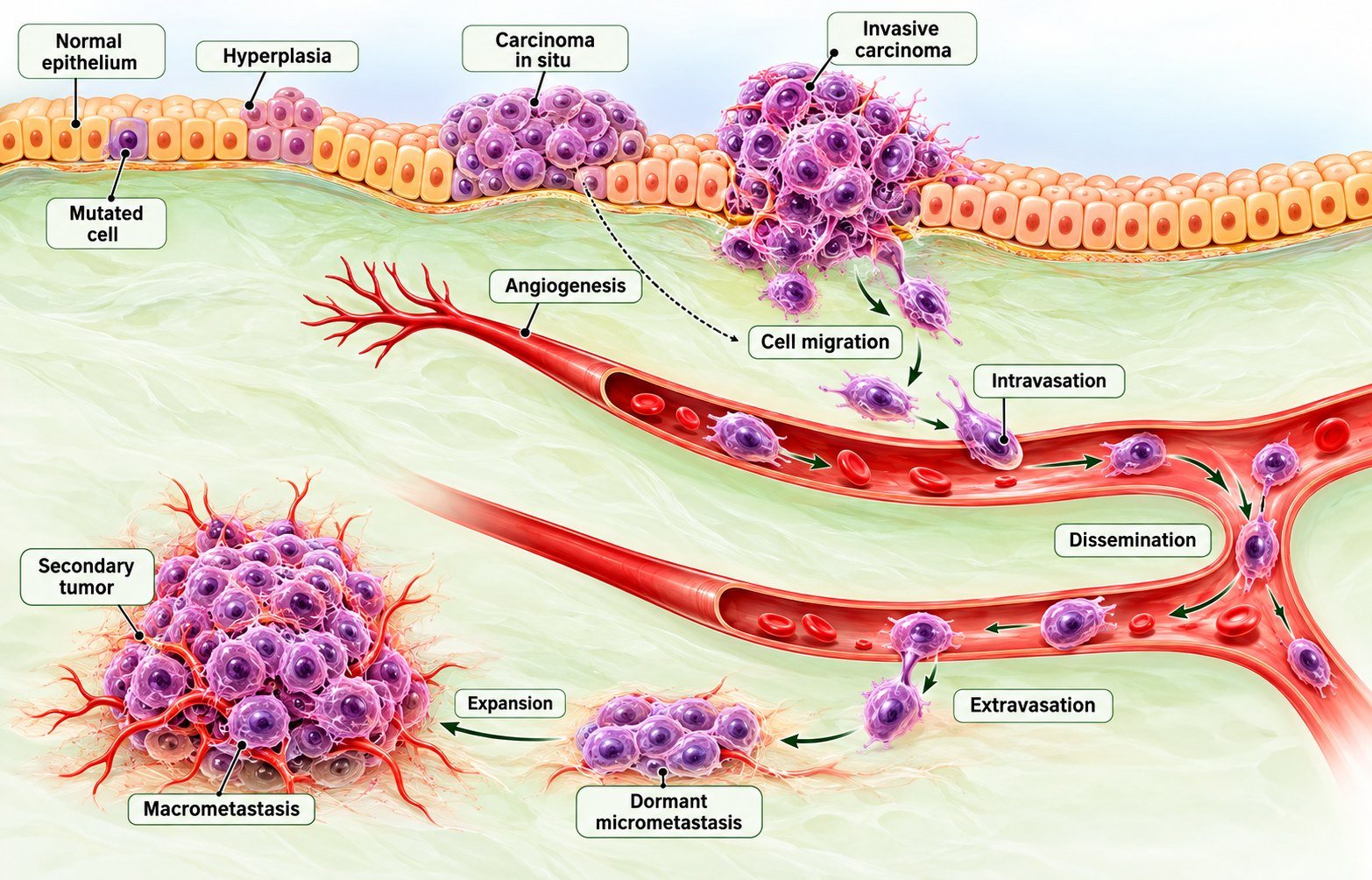
Cancer development may begin when a cell’s DNA is damaged or when normal mechanisms controlling cell division and repair become disturbed. If the damage is not corrected, the altered cell may survive and pass the abnormal information to daughter cells.
Repeated exposure to growth-promoting conditions; including chronic inflammation, hormonal stimulation, oxidative stress or other cellular signals; may encourage the abnormal cell population to expand.
As abnormal cells continue to divide, additional changes may develop. Some cells may acquire greater resistance to cell death, increased ability to obtain nutrients and enhanced capacity to survive in unfavourable conditions.
A growing malignant tumour may interact with and degrade surrounding tissue structures. This can allow cancer cells to move beyond the original site and infiltrate nearby tissues.
A tumour requires oxygen and nutrients to continue growing. To meet these demands, it may stimulate the formation of new blood vessels: a process known as angiogenesis.
Cancer cells may enter blood or lymphatic vessels, travel to other parts of the body, leave the circulation and establish secondary tumours. Metastasis is one of the major causes of cancer-related complications.
Some cancer cells may survive treatment because of biological heterogeneity, cellular adaptation, protective microenvironments or limited drug sensitivity. Surviving cells can contribute to disease recurrence in certain cases.
The “Hallmarks of Cancer” as described by Hanahan and Weinberg are the key biological capabilities that enable cancer cells to develop, survive, grow and spread. These hallmarks are not separate diseases; they are interconnected characteristics of malignant cells and their surrounding environment.

Cancer cells may continuously activate signals that encourage cell division. Unlike healthy cells, they can become less dependent on normal external growth controls.
Normal cells receive signals that limit excessive growth. Cancer cells may disable or bypass these growth-suppressing mechanisms, allowing abnormal multiplication to continue.
Programmed cell death, or apoptosis, helps remove damaged or unnecessary cells. Cancer cells may develop mechanisms that allow them to resist apoptosis and survive despite cellular damage.
Most normal cells have a limited capacity to divide. Cancer cells may acquire the ability to continue replicating for extended periods, contributing to tumour persistence.
Cancer cells can stimulate the formation of new blood vessels to obtain oxygen and nutrients. This process supports tumour growth and may facilitate the movement of cancer cells.
Cancer cells may acquire the ability to detach, invade surrounding tissues, enter circulation and establish growth at distant sites.
The immune system can identify and remove abnormal cells. Cancer cells may evade immune recognition, suppress immune responses or create an environment that protects them from immune attack.
Cancer cells may alter the way they use nutrients and generate energy. These changes can support rapid growth and survival under stressful conditions.
Persistent inflammation can contribute to tissue damage, cellular signalling, blood-vessel formation and an environment favourable to tumour growth.
Cancer cells often exhibit increased genetic instability. This can generate additional changes that promote growth, survival, invasion, treatment resistance and disease progression.
Cancer does not develop in isolation. Tumour-associated immune cells, connective tissue, blood vessels, signalling molecules and extracellular structures may interact with cancer cells and influence disease behaviour.
Some cancer cells may change their characteristics in response to stress or treatment. This flexibility can help them survive, adapt and spread.
See how Rejwin's formulation is designed to address these hallmarks, alongside the treatment prescribed by your doctor.
Read on About Rejwin